Oracle Redwood Design System Oracle Health Oracle Fusion

Scheduling at Scale
Across Two Platforms

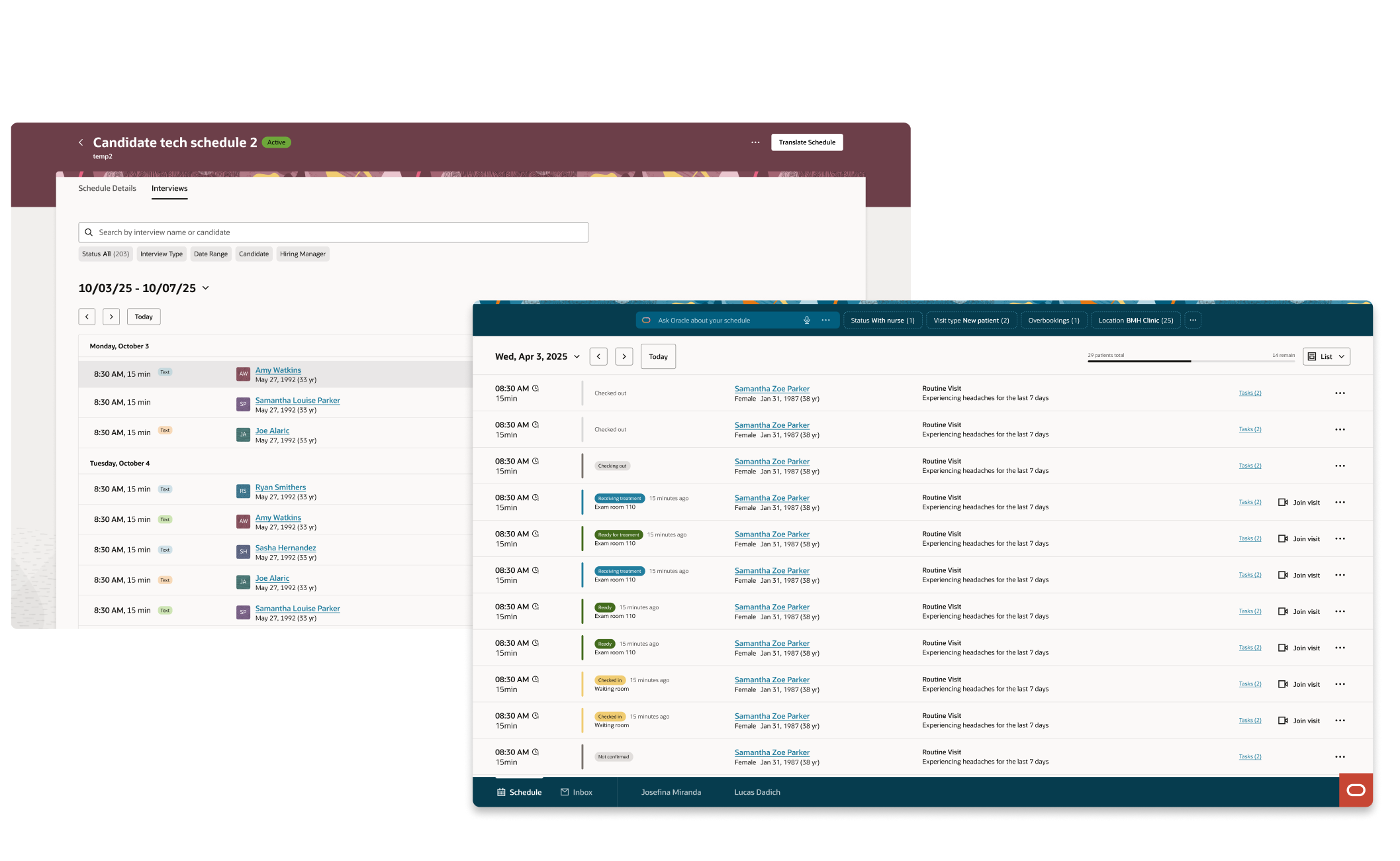
A unified scheduling pattern built inside Oracle's Redwood Design System, serving clinicians managing outpatient care in Oracle Health and recruiters tracking candidate interviews in Oracle Fusion HR.

Role
Lead UX Designer
System
Oracle Redwood
Platforms
Oracle Health · Oracle Fusion
Oracle Redwood Scheduling

One pattern. Two billion-dollar platforms.

Oracle Health and Oracle Fusion are two of Oracle's largest enterprise product lines. One serves the clinical workflows of health systems and physician practices. The other powers the HR operations of the world's largest organizations. Both needed the same thing: a scheduling experience that could surface the right information at the right moment for high-stakes, time-pressured users.

The work was built inside Oracle's Redwood Design System, Oracle's unified design language, which meant every pattern decision had to hold across both platforms without compromise. A clinician reviewing their patient schedule and a recruiter tracking a candidate's interview day are doing fundamentally different work, but the underlying cognitive demands are remarkably similar: who is this person, where are they in the process, what do I need to do next, and when.

The challenge was to design a scheduling component system with enough structural integrity to serve both domains, while remaining flexible enough that each platform's context came through clearly.

2
Billion-dollar Oracle platforms served by one shared pattern
1
Design system, Redwood, governing both implementations
2
Distinct user roles: clinical physicians and enterprise recruiters
E2E
End-to-end ownership from workflow definition to component spec

Two contexts.
The same core problem.

Before a single component could be designed, the team had to understand what scheduling actually meant in each domain, and where the experiences needed to converge.

Oracle Health, Clinical Scheduling
Physicians managing daily outpatient patient loads
High-volume, time-pressured clinical environments
Patients moving through rooms, care stages, and wait states
Clinical context: chief complaint, care history, urgency
Stakes: patient safety, care quality, throughput
Oracle Fusion, Interview Scheduling
Recruiters coordinating candidate interview days
Multi-interview sequences across panels and locations
Candidates moving through interview stages and decision gates
Professional context: role, interview type, interviewer
Stakes: candidate experience, hire quality, pipeline velocity
The insight that unlocked the pattern
Both users ask the same four questions in sequence: Who is this person? Where are they right now? What is the purpose of this interaction? What do I need to do next? A scheduling component system built around those four questions could serve both platforms without forcing either into a compromise.

Scheduling is never just a calendar.

In both Oracle Health and Oracle Fusion, the existing scheduling experience was organized around time, not around people, status, or action. That distinction matters enormously when you are managing twenty patients or ten candidates in a single day.

"I know when the appointment is. What I need to know is where the patient is right now, and whether I need to act before I get to them."
Clinical physician, outpatient setting
"The schedule tells me the interview is at 2pm. It doesn't tell me if the candidate has checked in, or if the last interviewer has submitted feedback yet."
Enterprise recruiter, Oracle Fusion

The root problem was identical across both platforms: the scheduling view surfaced time and appointment data, but not status, progression, or urgency. Users had to hold the missing context in their heads, or navigate away to find it. In clinical care, that cognitive overhead directly affects throughput and patient safety. In recruiting, it creates pipeline friction and candidate experience failures.

Design for progression,
not just time.

The opportunity was to reframe both scheduling experiences around the questions users were actually asking, and to do it through a shared Redwood component that could serve both platforms without requiring parallel design efforts.

The Redwood Design System provided the infrastructure: a consistent token system, established interaction patterns, and cross-platform governance. The design challenge was to use that infrastructure to build a scheduling pattern that treated people, patients, candidates, as the primary unit of organization, with time as a supporting signal rather than the organizing principle.

01
Primary unit
People first, time second
Each row in the schedule represents a person and their current status in the process, not a time block. Time anchors the row but does not define it. A patient who has been waiting forty minutes shows that urgency visually, independent of the clock position on screen.
02
Information hierarchy
Four questions, always answerable at a glance
The component was structured to answer who, where, why, and what next without requiring any additional navigation. Each field was assigned a visibility tier and validated against both clinical and HR workflows to ensure the hierarchy held across domains.
03
Status progression
Visible momentum through the day
Appointments and interviews move through defined stages, scheduled, checked in, in progress, pending action, complete. Each stage carries a distinct visual treatment in Redwood's token system, so users can scan an entire day's schedule and immediately understand where attention is needed.
04
Cross-platform flexibility
Shared structure, domain-specific context
The component's structural layout, row anatomy, status placement, action affordances, is fixed and governed by Redwood. The contextual fields each platform populates are configurable. A clinical row surfaces chief complaint and room location. A recruiting row surfaces interview type and panel status. Neither compromises the shared structure.

A Redwood scheduling pattern built to hold at enterprise scale.

The Clinician Organizer and the Interview Schedule share a single Redwood component architecture, designed once, implemented across two platforms serving millions of users.
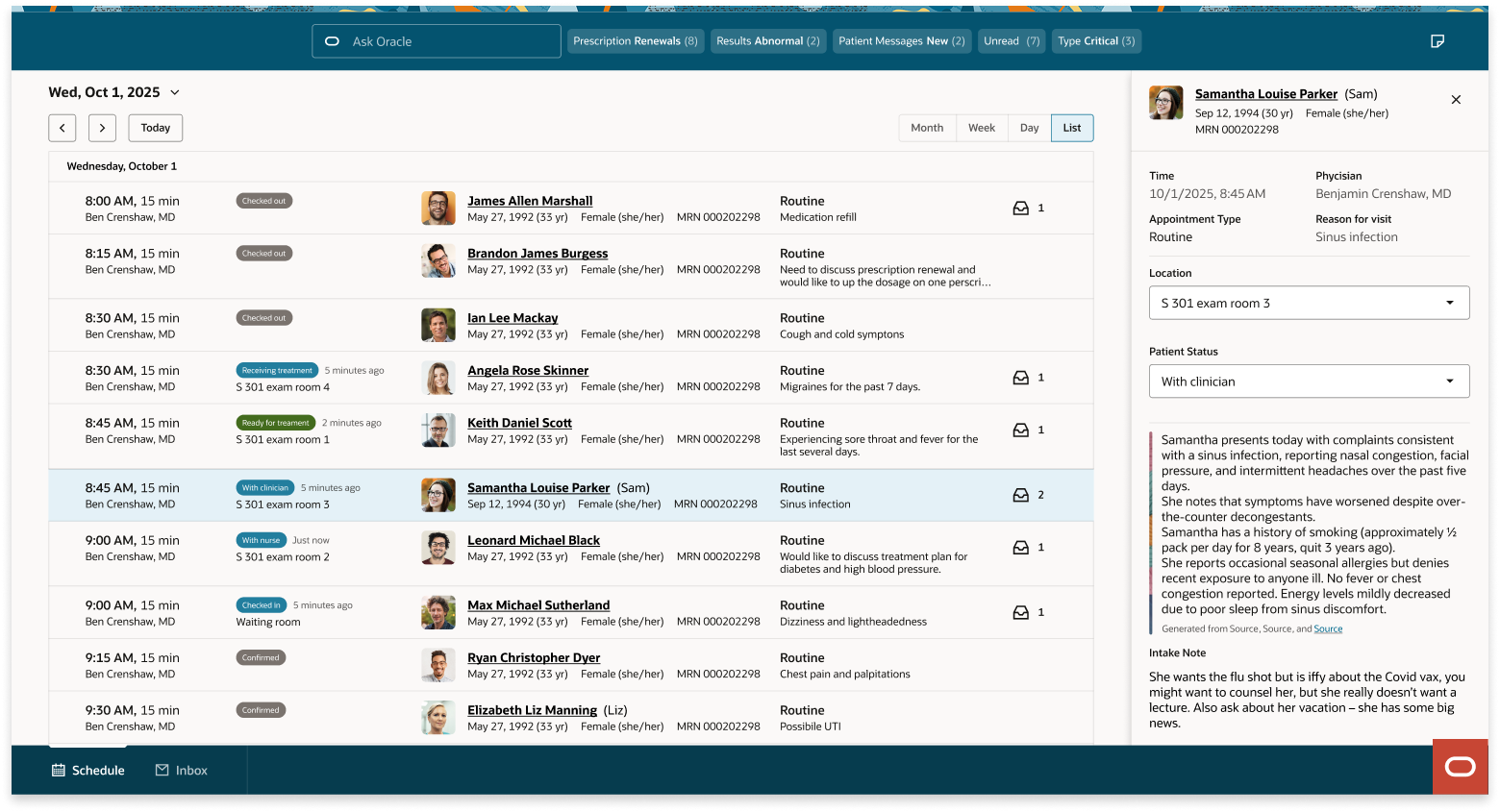
Clinician Organizer

Oracle Health, Clinician Organizer: patient flow, room status, chief complaint, and care-stage progression for outpatient physicians

Both implementations share the same component anatomy, the same token-based status system, the same accessibility standards, and the same interaction model. What differs is the data each platform provides and the actions each user can take.
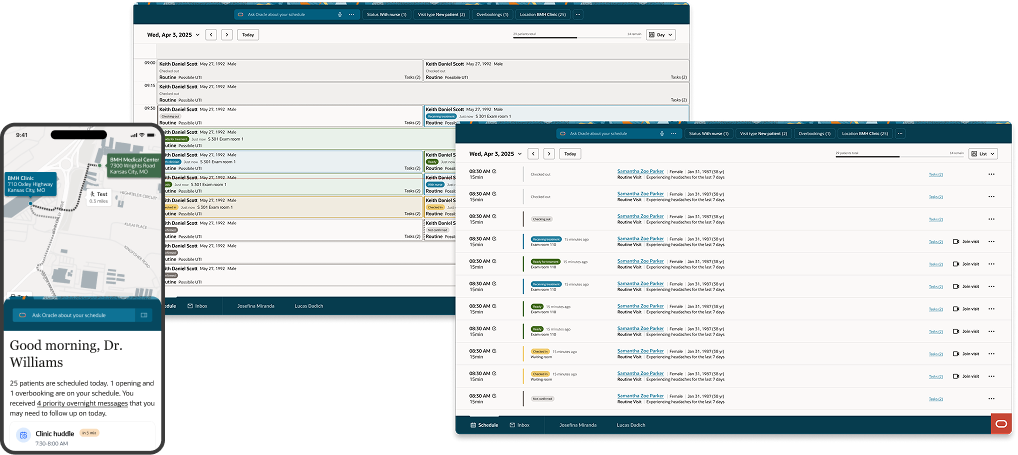
Clinical experience detail

The clinical scheduling experience in context, patient rows with live status, room location, and priority signals surfaced without secondary navigation.

Built inside Oracle's
enterprise design language.

Oracle Redwood is the design system that governs the visual and interaction language across Oracle's entire product portfolio. Building inside Redwood meant every decision had to be defensible at the system level, not just within a single product.

The scheduling pattern was not a one-off component. It was a contribution to the system itself, designed to establish a reusable model for any Oracle product that needs to represent sequential, status-driven interactions involving people moving through a process.

Component layer What was governed Flexibility surface
Row anatomy Fixed layout: person identity, status indicator, context fields, action zone Context field schema per platform
Status system Fixed token set: scheduled, active, pending, complete, urgent Label copy per platform context
Information hierarchy Tier 1 fields always visible, Tier 2 default, Tier 3 on demand Field assignment per platform
Interaction model Fixed: row selection, inline action disclosure, keyboard navigation Action set per platform workflow
Accessibility Full keyboard nav, screen reader structure, focus management None, non-negotiable
Accessibility as a non-negotiable
Full keyboard navigation was required for clinical environments where expert users rarely use a mouse. Screen reader support was built into the component structure from the start, not retrofitted. Focus management across complex interactions was specified before a single line of code was written.

What was delivered and what it prevented.

End-to-end ownership meant defining the workflow before touching the component, and establishing the patterns before either platform team started building.

What was delivered
End-to-end patient and candidate flow definition
Redwood scheduling component with full platform configuration spec
Status token system governing both implementations
Accessibility standards and keyboard interaction model
Cross-platform governance documentation for Redwood contribution
What was prevented
Parallel, inconsistent scheduling patterns across two platforms
Fragmented status systems requiring separate design and engineering
Costly accessibility retrofits after component adoption
Redwood contribution that served only one domain
Design debt at the scale of two enterprise product lines
The leverage of system-level work
A scheduling pattern built once inside Redwood serves every Oracle product that touches time, people, and process. The work done here does not stay in Oracle Health or Oracle Fusion. It compounds across the portfolio.

What this work taught me about designing for two masters.

Building a shared pattern for two platforms with fundamentally different users, data models, and organizational stakeholders is a different kind of design problem. The component has to be right for both, or it serves neither.

What worked well

Framing the design problem as four shared questions, who, where, why, what next, gave both platform teams a common language before any visual work began.
Building inside Redwood meant the governance was structural, not social. The system enforced consistency so individual platform teams didn't have to negotiate it.
Defining the fixed anatomy and flexible configuration surface early prevented both platforms from pulling the component in incompatible directions.
Accessibility as a first-class constraint from the start saved significant engineering rework and produced a better interaction model than retrofitting would have.

What's next

Predictive prioritization, surfacing which patients or candidates need attention before the clinician or recruiter has to ask, based on wait time, stage duration, and urgency signals.
Context-aware action recommendations embedded in the schedule row, reducing the navigation required to take the next step in the workflow.
GenAI-powered schedule summaries, a pre-shift or pre-day brief that synthesizes the schedule into the three things that most need attention.
Expanding the pattern to additional Oracle platforms where sequential, people-centered workflows exist beyond scheduling.
Let's talk about your
next big idea.

Whether you're exploring new solutions or improving what you already have, I am here to help.

Get in touch